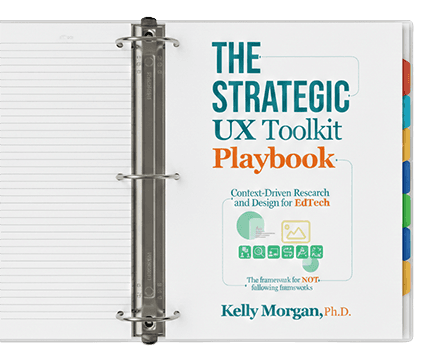
The Strategic UX Toolkit Playbook
Content-Driven Research and Design for EdTech
The Framework for NOT following frameworks
Instant Digital Access
$497
The book taught you how to think. Now get the tools to actually do it
The Problem
You understand why standard frameworks don't fit EdTech. You know about the three-user dynamic. You've thought through your context, your constraints, your seasonal access windows.
Now someone asks you to plan a research sprint in three weeks, and you're staring at a blank document.
You need templates for conducting strategic user interviews—not a chapter explaining why they matter. You need a synthesis log to run alongside your sessions, not a reminder that rolling synthesis exists. You need a way to map your three-user dynamics before you choose a method, not a framework to read when you have time.
Understanding the strategic approach isn't the same as being able to execute it. The Playbook is where the thinking becomes doing.
Instant Digital Access
$497
The Solution: Context Mapping
The Strategic UX Toolkit Playbook is the tactical implementation companion to The Strategic UX Toolkit book. Every phase corresponds to a book chapter. Every tool is ready to use.
You don't have to start at Phase 1. Enter wherever you need help right now—context assessment before a major initiative, method selection for a specific decision, synthesis support mid-research, or stakeholder advocacy when findings aren't moving anything. The phases build on each other, but each tool stands on its own.
The goal isn't template compliance. It's making defensible decisions based on appropriate evidence.
Who is this for?
Product managers who have research findings sitting in a deck that no one references
UX leads and researchers who need templates that account for EdTech's real constraints—not generic interview guides designed for consumer apps
Founding designers building a UX function from scratch and needing a starting point that doesn't require reinventing every template
Teams tired of running research that doesn't change what gets built
You don't need to have read the book first. But if you have, this is where the framework becomes your actual workflow.
The Strategic UX Toolkit
Stop building processes from scratch. Start with tools that fit EdTech's reality.

Phase 1: Assess Context
Before you choose a research method, you need to know your reality. Phase 1 maps your three-user dynamics, business constraints, existing research sources, tech debt, and UX maturity so you choose methods that fit—not methods that would work in a different company with different constraints.
Tools included: Context Mapping Workbook · Stakeholder Influence-Interest Matrix · From Context to Focused Research Questions
Phase 2: Select Tools & Artifacts
Not every decision needs the same level of research. A locked roadmap decision in three weeks requires different methods than exploratory discovery for a new product area. Phase 2 helps you determine your confidence threshold—research until you can make a defensible decision, then stop—and match methods to your specific constraints.
Tools included: Tool Selection Matrix (20+ methods filtered to what fits your context) · Heuristic Evaluation for EdTech · Strategic User Interview Guide · Usability Testing Protocol · Artifact Selection Guide
Phase 3: Execute Research & Build Buy-In
Research and stakeholder buy-in aren't separate activities. Phase 3 gives you execution frameworks for running sessions, synthesizing as you go—not in one overwhelming sprint at the end—and bringing stakeholders along so they trust findings by the time you present them, because they've watched you discover them.
Tools included: Recruitment Strategy Guide · Real-Time Synthesis Log · Finding/Insight/Implication Template · Creating Compelling Clips Guide · Progressive Buy-In Strategy Planner
Phase 4: Develop Strategy & Advocate for Direction
Insights don't automatically become direction. Phase 4 translates research findings into clear problem statements, design principles that function as decision filters, and stakeholder-aligned strategy—before you spend time on solutions. Get directional buy-in first. Design debates are a lot more productive when everyone already agrees on what you're solving.
Tools included: UX Strategy Worksheet · Problem Statement Templates · Trade-off Decision Frameworks · Advocating for Strategic Direction
Phase 5: Design Solutions & Advocate for Prioritization
Features are what you build. Tasks are what users accomplish. Phase 5 helps you design from user goals outward—mapping complete workflows, accounting for all three user types and the dependencies between them—and then actually get that work into production instead of onto a roadmap that never ships.
Tools included: Task Flow Mapping Worksheet · Knowledge Profile Template (an alternative to traditional personas built for EdTech's three-user reality) · Compromise Decision Framework
What this isn't
This isn't a prescriptive process to follow rigidly. Use what fits. Skip what doesn't. Adapt what almost works. Two guidelines apply: don't skip steps because they're hard—synthesis is tedious, stakeholder involvement feels awkward, advocacy is uncomfortable, and those are exactly the steps that separate research that influences decisions from research that sits in a deck. Do skip steps that don't serve your decision—if a simpler approach gets you to defensible, do the simpler thing.
The phases build on each other, but you can enter wherever you need help right now.
Instant Digital Access
$497
Start with the book first if…
the problem isn't that you lack templates—it's that your team keeps choosing the wrong approaches, or research keeps getting dismissed, or you can't explain to stakeholders why standard frameworks aren't working for you. The Strategic UX Toolkit gives you the strategic thinking to understand your context and make the case for a different approach.